Sunday, March 17, 2013

Opposing The Soda Ban Essay


Opposing The Soda Ban: Persuasive Essay
Jacob Sutton 708

   The New York City soda ban initiated by Mayor Bloomberg restricts the portion size on sugary sodas larger than 16 ounces, and applies to food service businesses regulated by the Department of Health including restaurants, food carts, sports arenas and movie theatres. This ban raises important questions on the right of government to control individual choice with the reason that they are protecting the public from consuming large amounts of unhealthy and sugary beverages.  There are several reasons why I oppose this ban.  First of all, while the overall health of citizens is something that should be taken seriously, it should not be Bloomberg’s place to limit people’s choice of what to put in their bodies.  Second of all, there are many loopholes around this ban, and if Bloomberg is so concerned with halting obesity, he should know that limiting soft drinks is just the beginning of solving a much bigger problem. Finally, instead of creating this ban, Bloomberg should consider healthier choice initiatives with more far-reaching results.
      
    According to Veronica Majerol in her article Sugar Wars in the New York Times, many people have argued that citizens should have the right and freedom to choose as they wish.  In this article, a twenty year-old college student, Zara Atal, says that it is none of government’s business. “If people want to drink their twenty-four ounce drinks, it’s their decision,” says Zara.  I believe that Americans should have the right to control what they can or cannot drink. Mayor Bloomberg seems to clearly be overreaching government’s control in people’s everyday lives. This kind of control on the rights of New Yorkers leads us to ask what will be banned next. Mayor Bloomberg could then try to ban other unhealthy habits such as smoking.  While people do have unhealthy habits and don’t always make the best choices for themselves, there are other ways to promote good health for New Yorkers.  

   There are also loopholes in the argument around the large size soda ban. According to the New York Times in an article by Michael Grynbaum, restaurants regulated by the government are not allowed to serve citizens larger than a 16-ounce soda can, though fast-food establishments like McDonalds and Burger King can still serve them. Since this is true, people can go to their regular 7-11 and buy a 54-ounce bottle of soda.  If people are seeking ways to consume large amounts of soda, there are certainly other means for them to obtain it, though it might be inconvenient. Even in the banned establishments, if people want more soda, they may just choose to get two smaller sizes.  For these reasons, the ban does not get at the core of the problem.

   There are obviously solid arguments on both sides of the ban.  Some people would argue that since 2/3 of adults in New York are obese or overweight, this ban might lower the rate of obesity levels in the city. They might also argue that it would impose more self-control for those who have none. However, research shows that soda alone is not the biggest cause of obesity in New York. It is only 43% of the added sugar in sugary drinks of the American diet according to the Alice Park in the article Goodbye Big Soda in the New York Times.  Fast-food restaurants like McDonalds serve burgers up to 1,000 calories. Therefore, it is not reasonable to blame or cite soda as the only culprit and cause in the fight against obesity in NYC.  While Bloomberg’s intentions are in the right place, he has overstepped his boundaries, and has taken on the role of a nutritionist rather than mayor.

   Mayor Bloomberg does have the right intentions for making New Yorkers healthier, but it does not seem as if he is going about this in the right way.  Instead of this ban, a better option might be to put a high tax on fatty foods and sugary drinks.  The money from these taxes could then be used to create healthy eating/nutritional education programs in schools.  There is no doubt that we must focus on making people aware of how to lead healthier lives, but we need to create programs that get to the core of this problem.  


Sunday, March 10, 2013

Go Ask Alice


Go Ask Alice
Anonymous


          Published in 1971, Go Ask Alice is the diary of a fifteen year old teenage girl whose life is turned upside down when she gets involved taking drugs.  At her friend's party, she is given a bottle of Coke with LSD in it and loves the way it makes her feel.  This begins her journey into drugs which leads her down a path where many serious and terrible things happen to her.
         I am only halfway through her diary, but it has really gotten me thinking about being a teenager and what can happen to a teen struggling with addiction and the social pressures of the drug world.  There are a few aspects to "Alice's'' personality (we don't know her real name) that seem to make her vulnerable and lead her to make some very poor choices for herself.  First of all, she is not very self-confident in the beginning of the story. She is not happy with her weight and she is having trouble finding new freinds and adjusting as her family has just moved to a new city.  At the party, this vulnerability leads her to accept the Coke with the LSD in order to feel accepted, boost her confidence, and fit in with other teenagers. I am hoping that "Alice" will overcome her drug use, but I will need to read on to find out if this is the direction she will follow.

Sunday, March 3, 2013

Number The Stars


Number The Stars by Lois Lowry
Jacob Sutton

          This past week, I reread Number the Stars by Lois Lowry which is a work of historical fiction about the bravery of a family as they help their Jewish friends escape from Copenhagen during World War II during the rise of Nazism.  Annemarie Johansen, one of the protagonists, risks her life to help her best friend, Ellen Rosen by pretending that Ellen is Annemarie's older sister.  The Nazi's have demanded lists of the Danish Jews and they are planning to use these lists to arrest and relocate the entire Jewish population.  In order to avoid being relocated, Ellen Rosen, disguised as Lise (Ellen's older sister who was killed by a car) comes to live with the Johansen's while her parents are taken in by Lise's fiance, Peter Neilsen.  One of the main themes of this work centers on the bravery of the characters during a very traumatic time in history.
          Annemarie learns the real meaning of bravery.  At first, she does not know whether she can stand up for what she believes to be right.  When she is faced with the knowledge that her best friend Ellen and her family will be "relocated" by the Nazi soldiers, she helps them escape from Denmark and risks her life several times to do so.  Annemarie learns that faced with these circumstances, even ordinary people like her must be brave.  Her Uncle Henrick tells her that "it is much easier to be brave if you do not know everything," that even brave people are frightened and if you are determined to stand up for what you believe, you do not consider the danger.
        Other characters in the book also show bravery. Annemarie's parents and sister, Kirsti demonstrate great bravery as they are confronted by the Nazi soldiers several times.  They are confronted when they are hiding Ellen, when they are on the train going to Gilleleje and also during a gathering to pay respects to Annemarie's Great Aunt Birte.  They ignore the dangers and do what they feel they need to do to protect Ellen and the other Jews.  Peter Neilsen is also very courageous as a member of the Danish Resistance.  All of them, in their own ways fight injustice and do all they can do to get their friends, who are Jewish, to safety.


Sunday, February 24, 2013

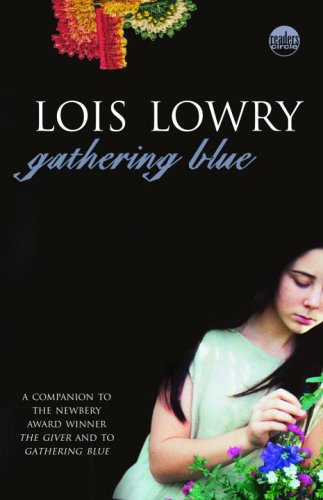
Gathering Blue by Lois Lowry


Gathering Blue
Lois Lowry

          I read The Giver last year and had been wanting to read its' companion, Gathering Blue by Lois Lowry and I have finally finished it.  Both books depict a futuristic society where the weak are cast aside, but in Gathering Blue, they are left to die in the fields.  Kiera, the protagonist, is an orphaned girl with a twisted leg whose mother, her only protector, has recently died.  After her mother's death, Kiera is brought to The Council of the Guardians.  Her life is spared when she proves that she can embroider well and is given the task of restoring the society's most valuable possession, a robe of the singer whose job it is to annually sing about the history of their civilization. They feel it is important to remember their past. Kiera is now considered valuable to the society because she can offer something that they need; she is able to dye colors in her embroidering, though neither she, nor anyone else can dye the color blue.
          Kiera's world is full of fear and a lack of security.  Kiera learns that people with gifts like her are treated well because they serve the society, but at the same time, they are held captive by the needs of others. She is motivated with her friend Thomas to find the color blue. On the day of the ceremony, Kiera is fixing the singer's robe and as he finishes the song, Kiera notices his chained and bloodied feet which are under the robe.  At this point, Kiera realizes that she must stay and change her corrupt society.  I believe she remembers her mother's words before she died and they help guide her to try to improve the world in which she lives.                                 
                                    "Take pride in your pain; you are stronger than those who have none."

Saturday, February 9, 2013

Fever 1793, Pt 2


Fever 1793   Part 2
Laurie Halse Anderson
 
     I have finished reading Fever, 1793 by Laurie Halse Anderson.  I can see now how the yellow fever epidemic directly effected Mattie's development throughout the book, from a typical teenage girl at the time, to victim, survivor, caregiver, and finally a mature version of herself. This crises and it's effect on Mattie is beautifully convayed as Laurie Halse Anderson describes the horrors of this time in history for her and others in Philidelphia.
     As victim, Mattie catches this contagious and terrible disease. In addition, her grandfather is attacked by thieves when they return to there coffee house a few weeks later. There are robbers everywhere. Mattie wittnesses her grandfather painfully die on the wooden floor of the ransacked coffee shop. Now she has no one to turn to. There are very few people on the streets and she cannot ask anyone for help.
     In the book, Mattie says that she is a survivor and she is not going to give up.  She has seen and felt the most terrible things and she seems to have the ability to understand and empathize with other people. For example, she helps a four year old girl named Nell who was orphand and on the streets. Mattie took her under her wing and treated Nell as though she was Mattie's first daughter. 
     Mattie also becomes a caregiver, not only for Nell, but others as well, For example, Mattie is reunited with her former maid and friend Eliza. She soon becomes an important part of Eliza's family. When her two nephews come down with the horrid fever, Mattie is always helping, never putting herself first.

                      "Trust me. please," I pleaded. ''They'll survive, I know they will. But if we
                      bleed them, we'll deliver them to the grave. We can't cut them". 

Mattie also begins working with Eliza in The Free African Society to nurse the citizens of Philadelphia back to health. Mattie and Eliza go from door to door, giving to those without food, and to those who were ill and needed care. Mattie's character develops in amazing ways, and she is empowered by helping others. 
     In the end, Mattie realizes what is truly important to her-her family, taking care of others and making their lives easier. Mattie partners with Eliza to run the coffee shop and Nell is always by Mattie's side as an official member of her family. Her crush Nathaniel Benson starts helping out in the business and draws pictures for the coffeeshop. It is clear that Mattie has deeply been affected by this terrible disease and has grown into a mature, responsible young lady.              


Sunday, January 27, 2013

Witches, by Rosalyn Schanzer


Witches! The Absolutely True Tale of Disaster in Salem 

by Rosalyn Schanzer

      I have become intrigued with the Salem Witch Trials, as we are studying this topic in social studies. This past week, I read the non-fiction accounts of the Salem witch hunts and trials of 1692 in the Mass Bay colony called, "Witches! The Absolutely True Tale of Disaster in Salem, by Rosalyn Schanzer.  It's a really interesting look back into the Puritan beliefs and the simple law system in Salem in the colonial times, and the simple laws they had at the time. These true facts in the book include those who were accused, hanged, and the mass hysteria belief of withcraft. It was very strange to learn about the law system where judges of the court were not actually educated in law, and the accused "witches" were not allowed to have their own lawyers while on trial.
      In the town of Salem Village, Massachusetts in 1692, two girls, Betty Parris and Ann Putnam start to exhibit strange behaviors such as seizures, twiching, contorting there bodies into strange shapes, and screaming. The village doctor could not find a remedy to cure these young Puritans.  He announces they were "Bewitched". This was the beginning of accusations that took over the entire community in Salem, and ruined dozens of lives. 
      As I continue to learn more about this fascinating, strange, cruel, and unreal topic, I am bewildered.  Rosalyn Schanzer has made me wonder about why this happened at this time in history.  What circumstances caused these irrational ideas to take over an entire community?  Was it because  of fear?  The Puritans lived with constant hardship and terror.  They came to a new land, and were deeply religious trying to find the right place to worship.  There were many struggles for basic needs, and it seemed as if these were very difficult times to live in.  Sometimes these kinds of circumstances can cause people to not think clearly.  In addition, the villagers were poor, struggling farmers, while people nearer to the town of Salem were generally wealthier merchants. Since the villagers accused the merchants, they might have envied their circumstances and caused this blame which pervaded the whole village.  In this book, we are lead to wonder about all of these factors which might potentially offer an explanation for the irrational ideas that spread throughout the community of Salem in 1692.

Monday, January 21, 2013

Guitar Boy

Guitar Boy
by MJ Auch

This past week I read the fiction book Guitar Boy by MJ Auch.  I thought this book was very compelling.  In the book, Travis Tacey doesn’t have it easy. His mom is in the hospital suffering from brain damage after a terrible car accident, and his father has kicked Travis out of the house.  Homeless, no money, and only 14 years old, Travis tries to make money from his guitar playing.  But when his cherished guitar is stolen Travis doesn’t know what to do.  With luck he gets a job a guitar maker’s shop.  With Travis’ love of music, devotion to his family, and kindness to others, he starts to make a new life for himself.

Scott Mckissask, the owner of the shop, and his friends, treat Travis well.  When Scott’s friend Clarence finds out that Travis has been kicked out of his house, he takes him in.  Travis tells Clarence that his mother had been in a car accident and is now recovering in a nursing home, but he doesn’t know where.  Clarence knows that Travis has lost a lot and tries to find the nursing home Travis’ mother is in. When Clarence finds the nursing home, Travis is overjoyed. 

            Travis borrows a new guitar from Scott, and since Travis knows his mom loves hearing him play the guitar, he decides to bring it with him on his visit to the nursing home.  At the nursing home, Travis plays the guitar for his mom. Travis’s mom has Aphasia a result of the car crash. As a result she can think of something to say,  but can’t actually say it. Even though his mom can’t speak, Travis’s guitar playing really perks her up.  Travis convinces Clarence to take him to the nursing home everyday and Travis’ guitar playing eventually leads to speed his mother’s recovery.